It’s a question that comes up all the time. In pre-sales calls, during audits, sometimes even in casual conversations.
Is Magento still worth it today?
A few years ago, the answer was almost obvious. As soon as a project became even slightly serious, Magento was part of the default options. Today, that’s no longer the case. The market has evolved, alternatives have matured, and some of them have removed barriers that used to exist.
Between Shopify enabling you to launch a store in a matter of days, WooCommerce leveraging the entire WordPress ecosystem, and headless architectures promising total flexibility, Magento can easily feel heavy, maybe even outdated.
The reality is more nuanced.
Magento hasn’t disappeared. It has repositioned itself. And to understand where it still makes sense, you first need to step back and look at the bigger picture.
The e-commerce landscape today: plenty of options, not always clarity
If you take a step back, it becomes clear that today’s e-commerce platforms are not solving the same problems.
SaaS platforms, with Shopify leading the way, dominate simple to mid-level projects. Their value proposition is straightforward and, to be fair, effective. You get up and running quickly, infrastructure is handled for you, security is not your concern. For a merchant who just wants to start selling without building a complex system, this is often the most rational choice.
On the other side, open source solutions like PrestaShop or WooCommerce offer more control, but they shift the problem elsewhere. Instead of depending on a vendor, you depend on an ecosystem of plugins, with all the implications that come with it: varying quality, maintenance issues, and sometimes an accumulation of technical debt.
In between, a third approach has gained traction over the past few years: headless. Solutions like commercetools allow you to fully decouple frontend and backend and build a tailored architecture. On paper, it’s very appealing. In reality, it requires a level of technical and organizational maturity that not every project has.
What’s interesting is that Magento no longer fits neatly into any of these categories. It’s not as simple as SaaS, not as lightweight as traditional open source CMS, and not as radical as pure headless architectures.
That’s precisely why comparing it “in general” no longer makes sense. You have to think in context.
Comparing CMS platforms: understanding trade-offs instead of looking for a winner
You often see comparison charts, rankings, “best CMS in 2026” articles. In practice, they’re not very helpful.
A CMS is not a neutral product you can objectively rank. It’s a set of trade-offs.
If you choose Shopify, you’re prioritizing speed and operational simplicity. You can launch quickly, test your market, iterate without worrying about infrastructure. In return, you accept working within a predefined framework. As long as your needs fit within that framework, everything works smoothly. As soon as you step outside of it, workarounds start to appear.
With WooCommerce or PrestaShop, you gain flexibility, but you often end up dealing with an accumulation of plugins. Individually, they do their job. Together, they can become difficult to maintain, especially as complexity grows.
Headless approaches, using solutions like commercetools, push this logic even further. You build exactly what you need, using the technologies you choose. But this freedom comes at a cost. Not just in initial development, but in coordination. When something critical breaks, identifying the root cause across multiple services is not always straightforward.
Magento sits somewhere else in this landscape.
It doesn’t try to simplify the problem.
It assumes your business is already complex and gives you the tools to model that complexity.
That can feel heavier at the beginning, but it often makes more sense in the long run.
When Magento is still the right choice
Rather than defending Magento in general, it’s more useful to look at the situations where it truly adds value.
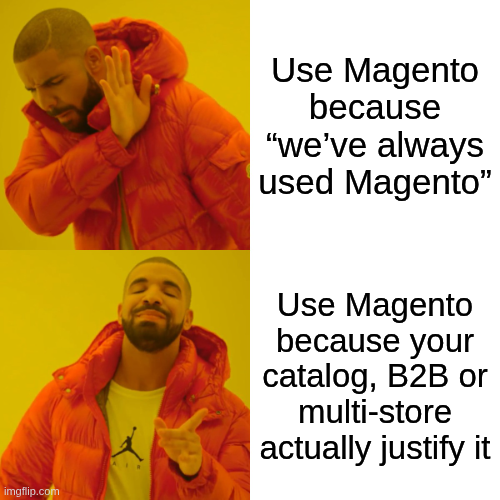
The first one is complex catalogs. As soon as you’re dealing with products that have many attributes, multiple configurations, or specific pricing rules, Magento becomes naturally relevant. It’s not just about doing more, it’s about being structured for that level of complexity.
The second one is serious B2B. Not just a “pro account” with tax-excluded prices, but a real B2B setup: company accounts with multiple users, negotiated pricing, approval workflows, payment terms, and ERP integrations. In that context, Magento remains significantly more comfortable than most SaaS solutions.
The third one is multi-store architectures. Managing multiple brands, countries, languages, with shared or separate catalogs, all from a single backend, is still one of Magento’s strongest points. Where other platforms require multiple instances or complex workarounds, Magento provides a consistent framework.
Then there are projects with strong business logic. As soon as your e-commerce is no longer “standard” and requires custom rules, integrations, or workflows, Magento’s extensibility becomes a real asset. It requires discipline, but it allows you to go far without breaking the framework.
Finally, there’s the question of control. With Magento Open Source, you fully control your code, infrastructure, and data. For some companies, especially in Europe, this is becoming an increasingly important factor.
Of course, this comes with constraints. Magento requires a solid technical team or a reliable partner. Without that, projects tend to drift and become difficult to maintain.
At OpenITech, we believe in pragmatism. Yes, we work with Magento, but that doesn’t mean it should be the default answer to every e-commerce project.
Today’s market offers highly effective solutions for simple or mid-level needs, and it would make no sense to ignore them. In many cases, they allow you to move faster and keep costs under control.
However, as soon as a project becomes more strategic, the catalog grows in complexity, business logic starts to matter, or the organization expands across multiple markets, Magento becomes a very serious option again.
Not because it is more modern or easier, but because it embraces complexity instead of trying to work around it.
And in the long run, that’s often what makes the difference between a project that works in the short term and a platform that can evolve over several years.
Want to dive deeper? Take a look at our article on Magento UX challenges in 2026.
Need an audit, ongoing maintenance, or just have questions? Get in touch with us.